Lyrics lookup and synchronization
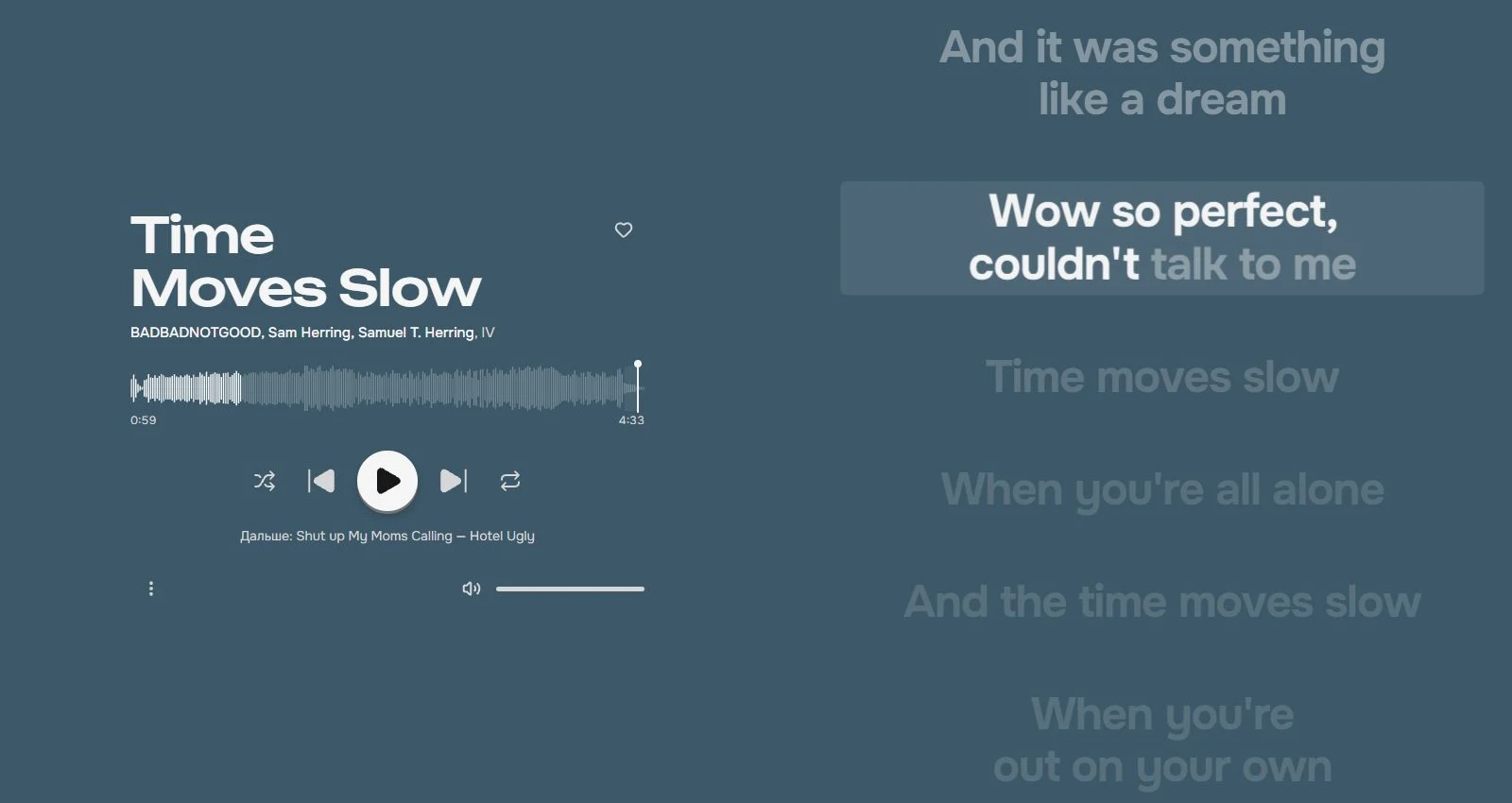
Caimack follows the player clock and shows the timing available from a verified source. Word or syllable timing enables karaoke highlighting. Line timing highlights the current line, and lyrics without timing appear as plain text. In the web and desktop players, scrolling through timed lyrics pauses automatic scrolling. Choose Back to current line to follow playback again.
Where lyrics come from
The Rust enrichment worker searches LRCLIB, Unison, Better Lyrics TTML, Better Lyrics QQ, NetEase, QQ Music, Genius, Megalobiz, Kugou, and lyrics.ovh concurrently. SimpMusic is queried using a video ID obtained from an identity-checked Unison record; local filenames are never treated as YouTube IDs. No Python process, audio transcription, or invented word timing is involved.
Each source has a 12-second lookup budget, HTTP requests time out after five
seconds, response bodies are capped at 2 MiB, and shared host schedules respect
rate limits and Retry-After. Endpoints returning HTTP 410 are treated as retired
until process restart, rather
than failing every subsequent lookup. LRCLIB retains its shared request spacing
and exponential backoff. A failed source does not discard another source's hit.
If no hit exists and a source failed, the durable job retries rather than treating
the failure as a definitive absence of lyrics.
Matching and choosing a result
Title, leading artist, recording version and duration are checked before accepting a result. Matching tolerates deterministic Cyrillic transliteration and common presentation/remaster decorations. Live/acoustic/cover editions cannot inherit the original recording's lyrics. Sped/slowed/remix base-title fallbacks can supply plain text, with all timing removed. Unknown or incompatible durations also remove synchronization.
Exact recording matches take precedence, then synchronization coverage, then duration proximity. Real word/syllable intervals outrank line timing; line timing outranks plain text. To avoid replacing a whole song with one timed verse, a candidate must contain at least 70% of the longest verified text in the lookup. The same completeness guard applies when upgrading a saved result.
Storage and playback
track_lyrics.synced remains a JSON array with backwards-compatible at and
text fields. A rich line additionally has end, words: [{at, end, text}], and
optionally background. Times are integer milliseconds. Translation and
romanization spans are excluded from the original vocal text. TTML clock and
relative offset expressions, frame/tick rates, enhanced LRC offsets, QRC, and YRC
are parsed and validated. Plain LRC never acquires synthetic word intervals.
Provider credit rows (such as 作词, 作曲, Lyrics by, and Composed by) and
matching title/artist headers are removed from displayed lyrics. Credit envelopes
are filtered before format detection because an LRC response can begin with YRC
credits. LRC metadata stays available during parsing so offsets remain correct.
Existing cached responses receive the same display cleanup without changing vocal
intervals; original provider payloads remain available for provenance.
Migration 0003_rich_lyrics.sql adds provenance, original source text, match
metadata, and a generated quality column. Network work finishes before the short
database transaction. The transaction rechecks recording identity, and a
conditional upsert atomically rejects manual replacements, poorer matches,
downgrades and incomplete text. Metadata edits invalidate provider results while
preserving manual text. Existing catalog entries are scheduled for improvement.
Complete word/syllable hits are revisited after 30 days, other successful hits after one day, misses after seven days, and failures use exponential backoff. Opening a due lyric gives that track priority without bypassing backoff. Web and Android views refresh incomplete results while open and stop polling once rich or manual lyrics arrive. Both paint from the player clock, so pause, buffering, playback speed and backward seeks do not drift. Reduced motion avoids frame animation. The editor keeps the original rich source text when available.
Provider configuration and attribution
LRCLIB_BASE_URL continues to configure LRCLIB. Optional
BETTER_LYRICS_API_KEY supplies the Better Lyrics X-API-Key header.
Docker Compose forwards the same setting from the root .env file. The public
TTML endpoint may only serve cached requests without a key. Better Lyrics TTML
must contain explicit song/artist identity metadata; an ambiguous response is
discarded even if the API returns HTTP 200.
Unison uses https://unison.betterlyrics.org; its lyric page and submitter credits
are persisted and displayed in both clients. Useful provider references:
Apply database migrations before deploying the API. Caimack keeps the existing audio files and looks up improvements in the background.
Verification
Rust unit/HTTP fixture tests cover parsers, identity checks, partial results,
provider adapters, shared cooldowns and truncation guards. A PostgreSQL integration
test exercises upgrades, API decoding, manual preservation and stale recording
rejection (integration-tests feature). Frontend and Android tests cover old
responses, word progress, overlapping vocals and backwards seeks. The ignored
live_lookup_smoke test queries external providers explicitly; ordinary tests
remain independent of their availability.